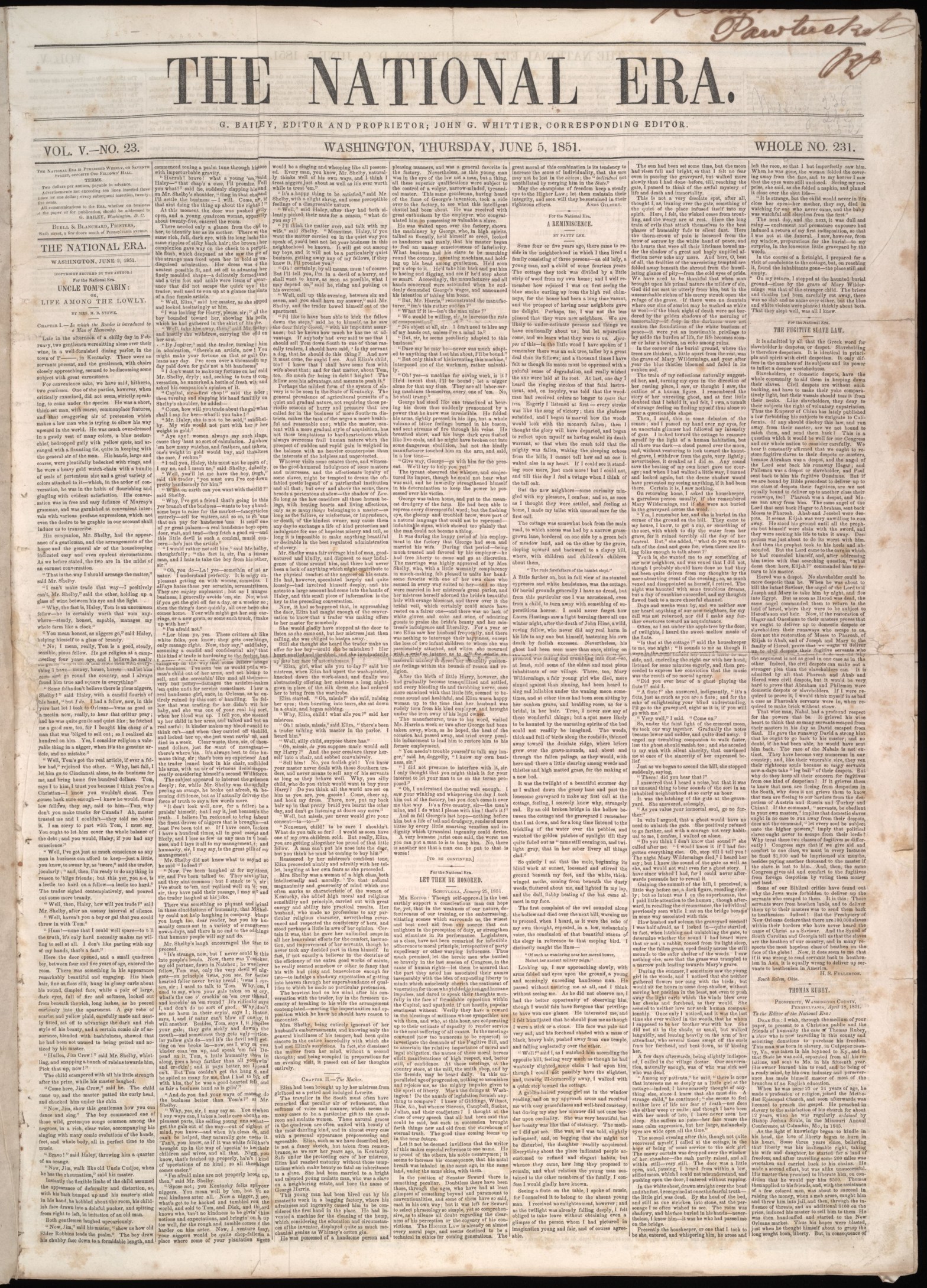
Harriet Beecher Stowe’s novel Uncle Tom’s Cabin is regarded as a classic, and though I thoroughly enjoyed reading it, I finished it with the decided opinion that it wasn’t as good as many of the other classics that I have read (take Pride and Prejudice, for example). My mom was of a similar opinion when she read the book more than twenty years ago. We struck up a conversation along this vein, and a question came up: why is Uncle Tom’s Cabin such a well-known novel, such a classic, when (to us) it doesn’t seem like it’s as good as the others?
I found my answer in James McPherson’s Battle Cry of Freedom. “It is not possible to measure precisely the political influence of Uncle Tom’s Cabin,” McPherson wrote,
Yet few contemporaries doubted its power. “Never was there such a literary coup-de-main as this,” said Henry Wadsworth Longfellow… The vehemence of southern denunciations of Mrs. Stowe’s “falsehoods” and “distortions” was perhaps the best gauge of how close they hit home (89-90).
I would argue that the reason Uncle Tom’s Cabin is such a classic is because of the change Harriet Beecher Stowe advocated for when she wrote it, and the transformation it brought.
Uncle Tom’s Cabin was written in response to the second Fugitive Slave Act, a law that allowed slaves who had escaped to the Northern free states to be reclaimed by their owners. Stowe wrote it to “make this whole nation feel what an accursed thing slavery is” (89). She had some experience with runaway slaves and bondage in Kentucky, and she drew from that to create a novel that didn’t just target the South, but the North as well.
Stowe immediately discourages the idea that all slave owners are cruel, unkind people. Tom’s first masters, the Shelbys, are human people who consider themselves to be good Christains. Mrs. Shelby in particular was loath to sell Tom down south, but Mr. Shelby smothered his conscience by insisting “I can’t help myself” (83). When his wife protested, he responded,
We men of the world must wink pretty hard at various things, and get used to a deal that isn’t the exact thing… But now, my dear, I trust you see the necessity of the thing, and you see that I have done the very best that circumstances would allow… if you knew the man [Mr. Haley] as I do, you’d think that we had had a narrow escape (85).
Tom’s second owner, St. Claire, is also a well-meaning relaxed man who treated his slaves too well in his wife’s eyes, mostly letting them have their own ways and never whipping any of them. He promised Tom that he would have his freedom, and even started leisurely drawing up the papers, but was killed before the process could be completed. Both of these men were southern-born, with a good side to them, but Stowe shows well how they had been influenced by the slave culture.
Then Tom was sold to Mr. Simon Legree, the epitome of a cruel godless slave owner. On his way back to his plantation after buying Tom, Legree told a man,
I used to, when I fust begun, have considerable trouble fussin’ with ‘em and trying to make ‘em hold out,–doctorin’ on ‘em up when they’s sick, and givin’ on ‘em clothes and blankets… Law, ‘t wasn’t no sort o’ use; I lost money on ‘em, and ‘t was heaps ‘o trouble. Now, you see, I just put ‘em straight through, sick or well. When one nigger’s dead, I buy another; and I find it comes cheaper and easier, every way (485).
Legree worked his slaves until they dropped dead and then bought more. Accustomed to easily breaking slaves under his merciless rule, Legree hated Tom because he could not crush him and make him submit to his will even though, in the end, he killed him. The irony becomes apparent when it is revealed that Legree was born a Yankee.
Stowe introduces an interesting concept in a conversation between two men–one a planter of the kinder breed of slave owner and the other a young gentleman who was not from the south–after they overheard Legree’s speech. The slave owner assured the gentleman,
“You must not take that fellow to be any specimen of Southern planters… he is a mean, low, brutal fellow!”…
“And yet your laws allow him to hold any number of human beings subject to his absolute will, without even a shadow of protection; and, low as he is, you cannot say that there are not many of such.”
“Well,” said the other, “there are also many considerate and humane men among planters.”
“Granted,” said the young man; “but, in my opinion, it is you considerate, humane men, that are responsible for all the brutality and outrage wrought by these wretches; because, if it were not for your sanction and influence, the whole system could not keep foothold for an hour” (485).
Stowe drives her point home hard–Northerners as well as Southerners need to recognize the evils of slavery.
And Northerners did. Abraham Lincoln was hardly exaggerating when he reportedly greeted Stowe with the words, “So you’re the little woman who wrote the book that made this great war” (90). Uncle Tom’s Cabin was the bestseller of the year, with over 300,000 copies sold in the U.S. within a year of publication, not to mention sales in Britain.
Uncle Tom’s Cabin may not be as well written as some classics, but it was far more influential than many of them, because Stowe really did make the whole nation know what an accursed thing slavery is.
Featured image by the National Era, Washington DC – University of Virginia, wikipedia commons
 Ellen Sheehy