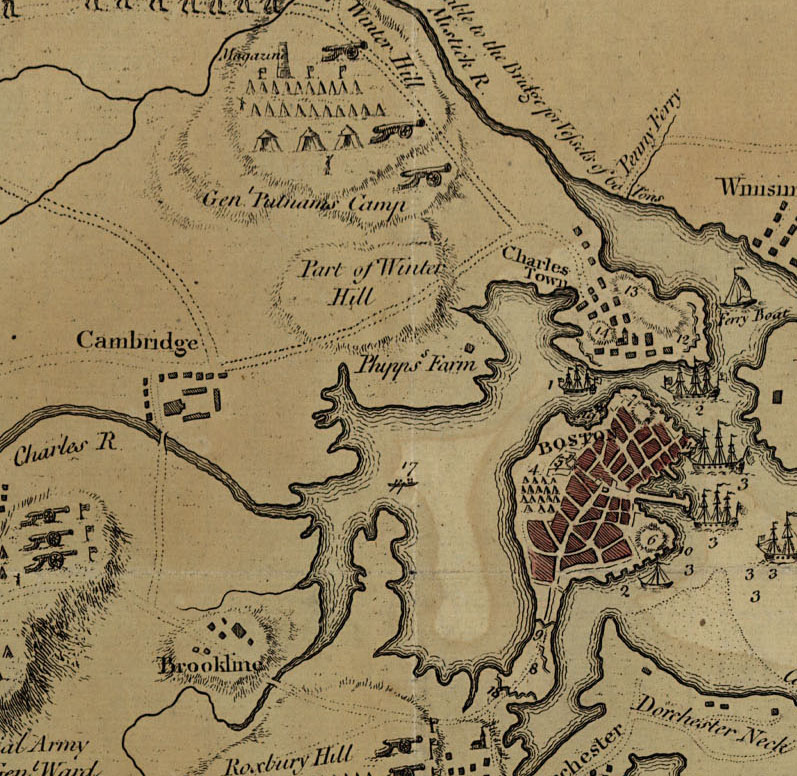
On Saturday, March 2nd, 1776, the British were not sleeping peacefully in Boston. They were exchanging gun and cannon fire with the American army camped outside their walls. But according to David McCullough in his book 1776, “Little damage was done by the exchange. It was nearly all noise.”
The Sunday night was similar, and on Monday, March 4th “the roar of the guns from both sides became more furious by far” (91). Little did the British know that on the night of the 4th the American troops were doing more than just shooting guns at Boston.
The American General Thomas and 2,000 men moved towards Dorchester Heights, twin hills on the Dorchester peninsula a mile and a half away from the British front lines. They moved along the Dorchester causeway, less than a mile from the British at Boston Neck, hidden by a barrier of hay bales. About 800 riflemen went ahead in case the British army “made any attempt to investigate during the night” (92). Behind the main group of soldiers came hundreds of carts and wagons loaded with materials for fortifications and guns. The men went to work immediately and slaved away all night. When the morning dawned on March 5th, an unwelcome sight met the eyes of the unsuspecting British. The Americans were hidden behind sturdy fortifications and had at least 20 cannons in place, ready to shoot. The British General, William Howe, was said to have exclaimed, “These fellows have done more work in one night than I could make my army do in three months” (93).
The result of the American’s hard work was that the British were forced to evacuate Boston with the Americans looking down their necks. General Howe could have, should have, and would have taken Dorchester Heights first if he had known what would happen.
Howe could have done things differently. He had many opportunities to take the Heights. They had remained unoccupied since the start of the siege of Boston months before, and if the British had taken them first it would probably have been the Americans that slogged away in defeat. And even if he had not taken the heights, he could have prevented the Americans from putting up such strong fortifications. Around 10 o’clock on the night of the 4th, a British lieutenant colonel, Sir John Campbell, told Brigadier General Francis Smith that the “rebels were at work on Dorchester Heights” (93). Smith ignored it. Smith could have reported to Howe, and then Howe could have taken action.
He also should have done something instead of sitting in Boston for months without doing much of anything besides keeping an eye on the Americans. To give him credit, he did not receive any helpful orders from England, and therefore was on his own, but that doesn’t change that he should have taken the Heights first. Smith should have taken action as well and told Howe what was going on instead of just blowing it off. Then the British might have been able to drive the Americans away.
And, in hindsight, I believe that Howe probably would have taken the Heights first or at least tried harder to prevent the Americans from taking them. If he had known exactly how instrumental Dorchester Heights would be for driving him out of Boston, he never would have sat and waited. And General Smith would have told Howe his choice bit of information that he had received on that fateful Monday night.
It would most likely have changed the history of America if General Howe had acted first. If he had taken Dorchester Heights first, before the Americans did, and if he had seen the Heights like Washington did, he might have beaten the American army and stopped the Revolutionary War before it began. And if Brigadier General Smith had passed on the news he had received, that chance was still there—even if it was less of a chance. It is crazy to think that if General Howe had known what would have happened, and if he had acted differently, America may never have become America.
But no matter what could have been done, should have been done, and would have been done in that situation, what happened was what God planned for that incident, and that is way better than anything George Washington or William Howe could have planned.
Works Cited:
McCullough, David. 1776. Simon & Schuster, 2005.
Featured image by By J. DeCosta – Library of Congress Geography and Map Division Washington, D.C., wikipedia commons.
 Ellen Sheehy