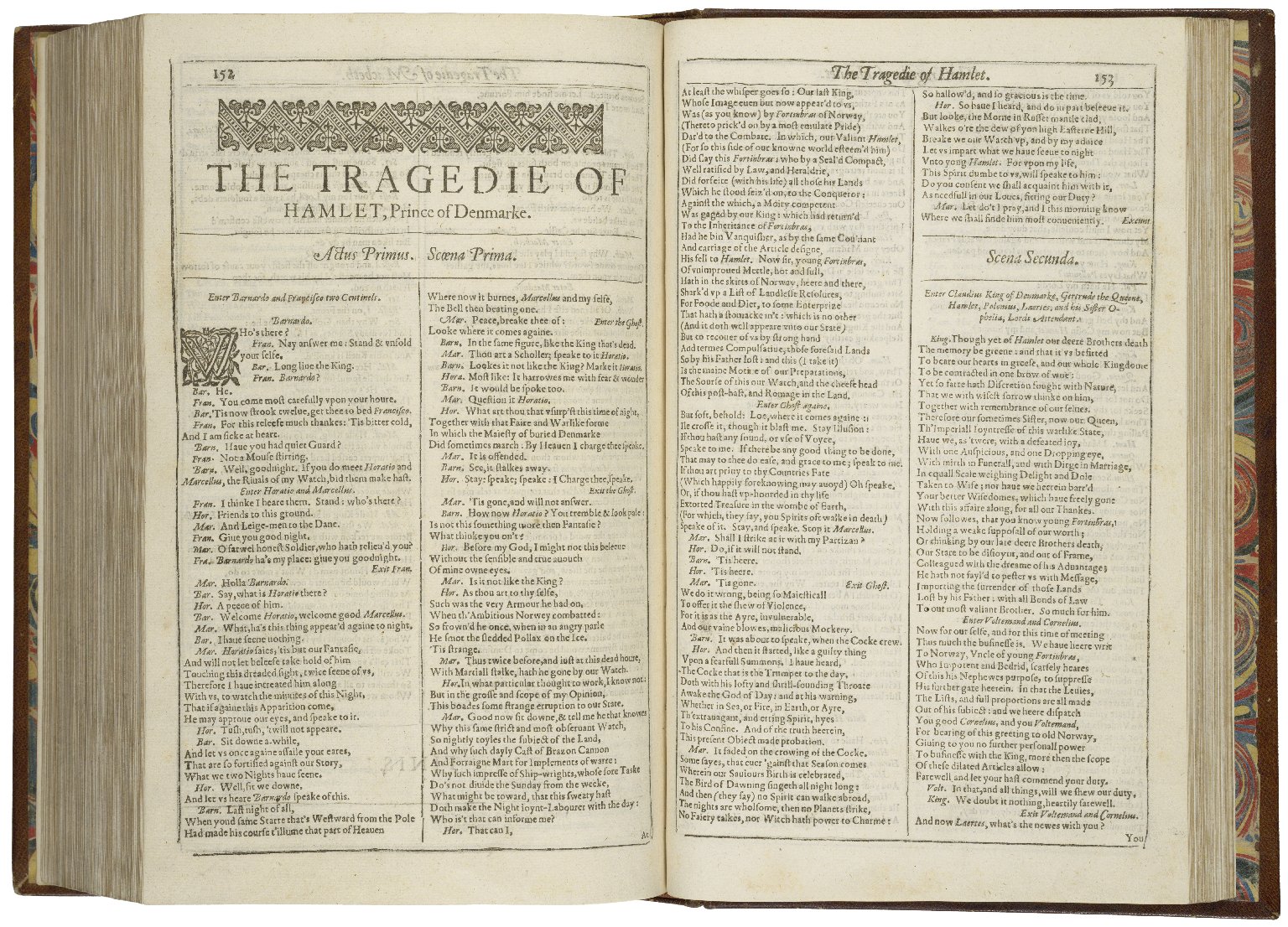
The Tragedy of Hamlet, Prince of Denmark, is full of life advice: Listen to freaky evil ghosts, they tell the truth. Check behind the curtains before you poke whoever is back there with your sword (you will have fewer people wanting to kill you). If you want to murder someone, pretend to be insane. Listen to your husband when he tells you not to drink the wine. Check what the letter says before you deliver it. To show your deep sorrow, jump around on your loved one’s grave. If you are going to fence with a poisoned sword, make sure your opponent is less skilled than you. And if you want revenge, just don’t. While these words of wisdom are valuable, there is a deeper message in Shakespeare’s play. Hamlet shows that life is messy, difficult, and full of unanswered questions.
Hamlet is characterized by his sadness, but I think it is safe to assume that Hamlet was a happier man before act one. He experienced a bit of freedom away from his parents, choosing his own bedtimes and friends, enjoying himself and the world, all in all living a normal life. And then he gets news that his father has died. He returns home for the funeral, and by the time he arrives his mother has married his uncle, Claudius. These two events combined shake him. His once orderly mind turns inside out with grief. He grows angry and suspicious of his mother’s hasty marriage, saying, “it cannot come to good” (I.ii.163), and when she tells him to stop mourning he replies with a biting speech expressing his deep “woe”(I.ii.89). In fact, Hamlet begins to question the very meaning of his life. Ever the drama king, he cries, “Oh God, God / How weary, stale, flat, and unprofitable / seem to me all the uses of this world! / . . . Things rank and gross in nature / possess it merely” (I.ii.136-138, 140-141). His life feels pointless and rotten because difficult things have happened to him. Those hardships raise questions in Hamlet’s mind, just as hardships raise questions in everyone’s minds. When things are not going how we want, we ask, why am I here? When we realize that our purpose is not to be pleased by the world, we wonder what it is.
As Hamlet’s struggles grow, so do his questions, until he reaches a psychological crisis. Through acts one, two, and three Hamlet discovers that his hunch was correct: nothing good is coming from the royal family’s current situation. His friends bring him to a cold dark place where the evil ghost of his father reveals that Claudius killed him by pouring poison in “the porches of [his] ears” (I.v.70) while he was taking an afternoon nap (who knew the flower garden could be such a dangerous place). Then, after an entire act of doing nothing except be insane, Hamlet gives his famous “to be or not to be” speech (III.i.64), in which he decides that the reason most people choose to live is because they are afraid of life after death, stating,
But that the dread of something after death,
The undiscovered country from whose bourn
No traveler returns, puzzles the will
And makes us rather bear those ills we have
Than fly to others that we know not of?
Thus conscience does make cowards of us all (III.i.86-91).
But while Hamlet recognizes this tendency of living out of fear, he doesn’t seem to agree with it. His tone is one of questioning, not asserting–he does not necessarily throw himself into the category of those he describes. There is no resolution in his thinking.
In act three, Hamlet stages a play reenacting Claudius’ murder of King Hamlet to discover if the ghost is telling the truth, and when Claudius storms out in high dudgeon, Hamlet sees the ghost was right. Yet Hamlet remains immobile, as paralyzed as the people he speaks of in his soliloquy. He is so stuck, in fact, that the freaky evil ghost reappears to urge him to get a move on (“This visitation / Is but to whet thy almost blunted purpose,” he tells him (III.iv.126-127)). Hamlet is like a dull sword that cannot kill anyone. But he finally acts by stabbing a mystery man behind the curtains in his mother’s room (incidentally, before the ghost comes back). He believed the man was Claudius, but it was actually Polonius, an advisor to the king. It was a dumb decision, and while the court was probably happy to have Polonius gone–he was annoying–Hamlet has now started down the path of revenge and he cannot turn back. He has to finish the job, and heads off to do so, dragging dead Polonius behind him.
This does not mean that he has answered all his questions, though. In act four, Hamlet has a long conversation with himself about the same question he asked in the beginning–what is his purpose? What is the meaning in his life? “What is a man / If his chief good and market of his time / Be but to sleep and feed? A beast, no more. / Sure He that made us with such large discourse, / looking before and after, gave us not / That capability and godlike reason / To fust in us unused” (IV.iv.35-41). Is a man even a man if he acts like an animal? If he does not use his mind? Hamlet goes on to say that he is not sure if longing for revenge is an animal trait or a godlike one, but he does not care; “O, from this time forth / My thoughts be bloody or nothing worth!” (IV.v.68-69). This is a climactic moment for Hamlet, one where he decides who he is, where he decides his reason for existence. No longer is he undecided, moping around in the corners, and no longer is he afraid. Be it good or bad, Hamlet wants revenge, and he will dedicate his life to it.
Sadly, he does not have much life left. It only takes one more act of the play for Hamlet to die, and somehow manage to kill almost all the other main characters as well (whether on purpose or inadvertently). His revenge ruins the entire royal family. The traps created by Claudius’ and Hamlet’s deception and murder caught them, and the rot Hamlet recognized in act one was purged from Denmark. This raises another question, one not directly asked: is it better to be indecisive, or live for a destructive and bad purpose? And I do not think Shakespeare answers this question. He leaves it hanging over Hamlet’s grave. Was Hamlet better off doing nothing, or doing wrong? Scheming by himself or killing his family members?
This is how life is. Hamlet is a dramatic character in many ways, exaggerated and melodramatic (not many of us have jumped onto pirate ships while sending our “friends” to their deaths, for example). But in other ways, he is just like us–confused, suffering, slightly overweight, experiencing a midlife crisis. The play is difficult to decipher, impossible to pin down, full of contradictions and questions, just like Hamlet’s mind, and just like our minds. In Hamlet, Shakespeare shines a spotlight on how messy and confusing life is, how thin the line between good and evil is, and how hardships raise questions that are sometimes never answered.
Featured image from Folger Shakespeare Library Digital Image Collection http://luna.folger.edu/luna/servlet/s/me1828, CC BY-SA 4.0, https://commons.wikimedia.org/w/index.php?curid=40907197
 Ellen Sheehy